Technology Leads Desert Restoration
Engineering Deserts into Oases
We build low‑cost, self‑accelerating ecological systems for the world's driest environments. Our technology uses upcycled waste — tyres, plastic bottles and cardboard — arranged as interlocking modules that stabilise sand, trap moisture, establish vegetation and attract desert wildlife. A KAUST‑based field pilot is in preparation, backed by national‑level approval under Saudi Arabia's Vision 2030.
A patented modular system that transforms waste materials into living micro‑habitats — restoring degraded desert land at scale.
Patent Highlights
China Patent: 202520439361.X
Saudi Arabia Patent: SA1020254994(under final review)
Tire-Based Plant Cultivation System for Vertical Desert Greening
(Utility Model Patent)
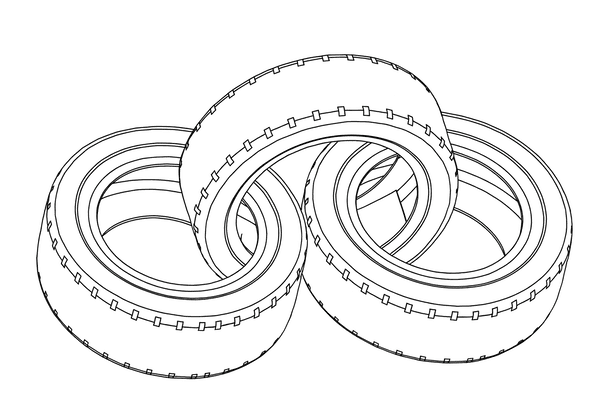
This utility model patent covers a modular plant cultivation system that repurposes scrap tyres into flat “fixed rings” and vertical “planting rings”, bridged by planter inserts to form a continuous structural belt.
The geometry does three things at once. It reduces near-ground wind speed, suppressing the sand movement that erodes seedlings and destabilises surfaces. It harvests night-time condensation within the tyre cavities. And with optional drip devices, it keeps seed beds moist through the establishment period — creating a protected micro-climate in which roots can develop before exposure becomes fatal.
The system stabilises moving sand and supports climbing plants or cash crops. Its modular form allows sections to be deployed, extended or repositioned without heavy equipment, and the interlocking design has shown higher survival rates and longer service life than traditional sand barriers.
Within hours of installation, the tyre cavities attract desert fauna — insects, reptiles and small mammals — which use them for shade, thermal buffering and shelter. Their activity deposits organic matter that soil microbes convert into fertility, so the structure begins building soil before vegetation is established.
Designed for low-cost, low-maintenance deployment at scale, the system advances circular-economy goals by converting upcycled materials — scrap tyres, recycled plastic containers and waste cardboard — into durable ecological infrastructure.
Patent status: China 202520439361.X (granted) · Saudi Arabia SA1020254994 (final review)
Available for licensing.
轮胎基植物栽培系统 —— 用于沙漠立体绿化
(实用新型专利)
本实用新型专利涵盖一种模块化植物栽培系统,将废旧轮胎改造为平铺的”固定环”与竖立的”种植环”,二者由种植槽嵌件连接,构成连续的带状结构。
该几何构型同时实现三重功能:降低近地面风速,抑制侵蚀幼苗、破坏地表稳定性的风沙活动;在轮胎内腔收集夜间冷凝水;配合可选配的滴灌装置,在定植期保持种子床湿润——营造受保护的微气候环境,使根系在暴露致死之前得以发育。
该系统可稳定移动沙丘,支持攀援植物或经济作物的生长。其模块化形态使各段无需重型设备即可部署、延伸或重新布置;互锁构造相比传统沙障表现出更高的存活率与更长的使用寿命。
结构安装后数小时内,轮胎内腔即吸引沙漠动物——昆虫、爬行类与小型哺乳动物——它们利用其遮蔽、热缓冲与庇护功能。动物活动沉积的有机质经土壤微生物转化为肥力,使该结构在植被建立之前就已开始构建土壤。
该系统设计用于低成本、低维护的规模化部署,通过将回收材料——废旧轮胎、再生塑料容器与废弃纸板——转化为耐久的生态基础设施,推进循环经济目标。
专利状态: 中国 202520439361.X(已授权)· 沙特阿拉伯 SA1020254994(终审中)
现已开放许可授权。
1. How It Works
The system is built around three interlocked functions, each powered by a different waste stream. Waste tyres are arranged as a two‑row interlocking belt — 60 cm high, 110 cm wide, extending as far as the site requires. Two‑litre plastic bottles, perforated and inverted, deliver slow‑release drip irrigation over weeks without pumps or power. Uncoated corrugated cardboard creates seed beds and microbial carriers that retain moisture in the root zone.
Together, the structure stabilises sand, suppresses the destructive near‑surface wind layer (0–50 cm above ground), and creates a sheltered micro‑climate where seedlings can establish and native vegetation can take hold.
2. The Refuge Island Effect
In hyper‑arid landscapes, the greatest scarcity is not water — it is safe, stable shelter. The tyre structure provides precisely that. Shade, moisture and thermal buffering within the cavities attract desert reptiles, insects and small mammals within hours of installation. Their activity brings organic matter — droppings, hair, fallen leaves — which soil microbes convert into fertility. Over time, the structure becomes not just a plant support but a living, self‑reinforcing micro‑ecosystem.
This “Refuge Island” mechanism is one of the system’s core findings: ecological recovery can begin before vegetation is established, driven by the fauna the structure attracts.
3. Scaling Through the Green Wall Domino Effect
When a single module belt is established and vegetated, it acts as a linear windbreak, sharply reducing wind energy and sand movement in its lee. The next belt, placed a few metres downstream, inherits a calmer, more stable environment — making its vegetation easier to establish. Each belt improves the conditions for the next. This domino effect allows restoration to scale systematically, from a single pilot belt to a network spanning kilometres.
4. Proven Foundation
The technology is protected by two patents: one granted in China (202520439361.X) and one in final review in Saudi Arabia (SA1020254994). A 90‑day scientific pilot is in preparation at the King Abdullah University of Science and Technology (KAUST), with validation designed in collaboration with KAUST researchers. The pilot site has received approval from Saudi Arabia’s National Center for Vegetation Cover (NCVC), and environmental monitoring includes soil quality, vegetation performance, water‑use efficiency and micro‑climate measurement.
The system aligns with Saudi Arabia’s Vision 2030, the Saudi Green Initiative and the Middle East Green Initiative — offering a replicable, low‑cost model for large‑scale arid‑land restoration.
ABOUT Jack Zhang
Ecological Engineering Strategist | Desert Infrastructure & Pipeline-Corridor Stability | Vision 2030 & SGI Aligned
I develop low-cost, scalable ecological systems that reduce sand movement and restore degraded desert land across Saudi pipeline corridors, right-of-way areas and infrastructure zones. My approach combines:
– 3D tyre-based sand-stabilisation modules (interlocked horizontal and vertical structures)
– Native climbing plants and microbial biocrusts for rapid cover and long-term stability
– Recycled cardboard seed–microbial carriers (2026 innovation)
– Passive water systems: slow-release drip reservoirs and condensate-harvesting coatings
The goal: less sand accumulation, lower O&M costs and reduced pipeline exposure risk, using circular-economy materials.
I work with engineers, scientists and government stakeholders, the KAUST research community, sustainability agencies, and pipeline integrity, O&M and digital transformation teams.
The technology is patented in my name (granted in China; in final review in Saudi Arabia), and a KAUST-based pilot is in preparation.
With 20+ years in manufacturing, systems design and change management, I focus on simple, practical solutions deployable across thousands of kilometres of desert infrastructure.